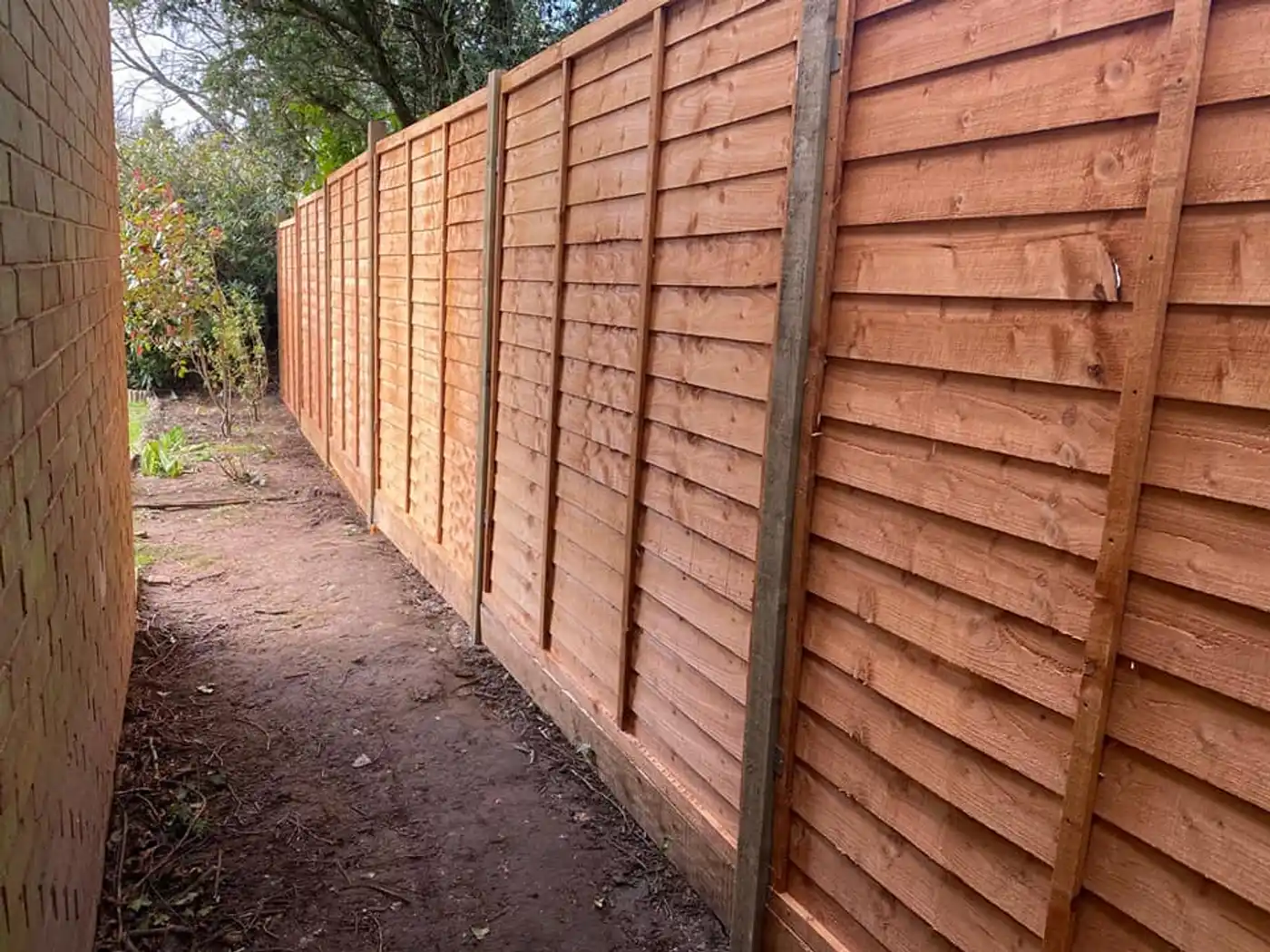
Why fences fail in Norfolk gardens
Most fences do not fail in the panel. They fail at the post, at ground level, and usually a long time before the storm that finally puts them over.
If you have ever pulled out a broken fence post and found the buried end still solid, that is not bad luck. It is how timber posts nearly always go.
Rot happens at the surface, not underground
Wood needs three things together to rot: moisture, oxygen, and the fungi that do the work. Take any one of them away and decay more or less stops.
Below ground there is plenty of moisture but very little oxygen. Well above ground there is plenty of oxygen, but the timber dries out between showers. Neither is a good place to rot.
The soil line has both at once. That narrow band where the post comes out of the ground stays damp, has air on all sides, and sits in direct contact with everything living in the soil. So that is where posts go, in a band of about four inches, while the timber above and below it stays sound.
This is worth knowing before you start digging. People assume the buried section has failed and set about excavating the whole post. More often the bottom is fine and the damage is at the surface, which changes what the repair needs to be.
Why Norfolk gardens see it sooner
Rot weakens the post. Wind is what finishes it.
Norfolk’s flat landscape leaves it exposed to storms and high winds, something North Norfolk District Council notes in its own emergency planning guidance. There is not much in the way of hills or dense woodland to slow weather down, so gardens here have fewer natural windbreaks than they would in more sheltered parts of the country.
That does not mean fences here are built badly. It means a post with a weak point at its base gets tested more often, and harder. A fence that might have limped on a few more years somewhere sheltered tends to go at the first proper blow.
Storm season runs from roughly October through to February. September is the month to look, because the work is a great deal easier before the ground is sodden.
A fence panel is a lever
Push the top of a six foot panel and you can feel what the wind is doing. The panel catches the load across its whole face and passes it into the posts. The rotted band at the base acts as the pivot.
That is why solid panels take the most punishment. Closeboard and overlap panels present a flat face with nowhere for the wind to go. Slatted and hit-and-miss panels let air through the gaps, which cuts the load on the posts considerably.
The trade-off is worth stating plainly: you lose some privacy. Hit-and-miss is the usual compromise, because the boards alternate on either side of the rail. You get a solid-looking fence when viewed straight on, with air still passing through it.
What to check, in about ten minutes
- Push each post at shoulder height and watch the base, not the top. Movement where the post meets the ground is your answer. A post that flexes along its length but stays put at the bottom is generally fine.
- Scrape the band from roughly two inches below soil level to two inches above. A screwdriver will do. Sound timber resists it. Rotten timber goes soft and comes away.
- Look for dark staining or a spongy feel at that height, even where the post still looks square from a distance.
- See whether the panels sit straight on soil. With no gravel board, the bottom rail wicks water up into the panel and will go the same way the posts did.
- Check for concrete spurs already bolted on. Someone has repaired this run before, which tells you the posts are at the end of their life rather than partway through it.
Concrete posts or timber
Both work. They fail differently.
Concrete posts do not rot, so the ground line stops being the weak point entirely. They will normally outlast several sets of panels, and panels slot straight into them without fixings. They are heavier to handle, they want a properly dug hole, and there is no getting around the fact that they look colder than timber.
Timber posts look better, particularly where the fence is meant to sit within the planting rather than just mark a boundary. They need the ground line protecting, whether that is by setting them properly, using a post sleeve, or shaping the concrete collar so water runs away from the post instead of pooling against it.
Gravel boards help either way. They keep the panel timber clear of wet ground, and when one eventually goes you replace a board rather than a whole panel.
Repair or replace
If one post has failed and the rest of the run tests genuinely sound, a concrete spur bolted to the failed post is a sensible repair and there is no reason to do more.
If the whole run went in at the same time, be realistic about it. Posts that share an installation date and the same soil tend to fail within a season or two of one another. Spurring them one at a time across three winters works out dearer than doing the run once.
Heights and neighbours
Two rules that save trouble.
You can put up a fence to two metres on a side or rear boundary without planning permission. Where the boundary adjoins a road or footpath used by vehicles, that drops to one metre. Trellis counts towards the total, so a two metre fence with trellis on top is a taller structure than permitted development allows.
If the fence is shared, it is worth a conversation before the work starts rather than after it.
If you want someone to look at it
Danny is City & Guilds trained in carpentry and joinery, which is mostly useful here for knowing when timber is worth saving and when it is not.
We fit fencing across Norwich and the surrounding villages. If a post has gone, or a run is starting to look tired, request a free quote and we will come out and have a look at it. There is more about how we work on the fencing page.
Not answered here?
Ring Danny and ask. He would rather talk it through than have you guessing.
Questions we get asked about this
01. Can I concrete a new post into the same hole?
Usually yes, but clear the old concrete and any rotten timber out first rather than setting a new post against it. Old material holds water against the new post and puts it straight back into the conditions that finished the last one. If the hole has collapsed or you are working next to a wall, a concrete spur bolted to the existing post is often the cleaner fix.
02. Whose fence is it, mine or my neighbour's?
The deeds are the only reliable answer. Plans sometimes mark boundaries with a T symbol on the side responsible for maintaining them. The common belief that you own the fence on your left is not a rule and has no legal basis. If the deeds are unclear, it is worth agreeing the work and the cost with your neighbour before anything comes down.
03. Is autumn too late to replace a fence?
No, and it is often better than waiting. Posts go in more easily before the ground is saturated, and getting a weak run sorted before storm season means you are not arranging it in January with a panel in the flowerbed. Genuinely hard frost is the main thing that holds work up, and that is normally later in the winter.
Get a free quote for your garden
Tell us what you need doing and Danny will come out, take a look and give you a price. No charge for the visit and no pressure afterwards.